Rose/House by Arkady Martine (and Piranesi by Susanna Clarke)
I recently finished Arkady Martine’s novella Rose/House. Like her earlier works A Memory Called Empire and A Desolation Called Peace, Rose/House is a clever character drama in a speculative setting. Rather than the deep space of the Teixcalaan series, Rose/House is set in a sort of climate dystopian (or, sadly, realist) near-future Earth, though.
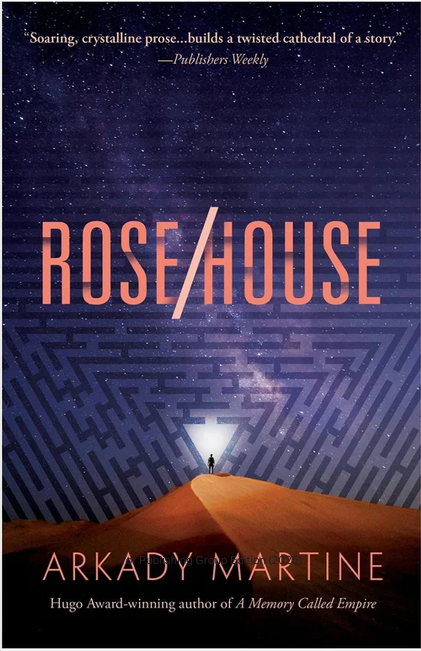
Bottom line: I liked Rose/House! Partly because it's good in the way Martine's books are and partly because it's good in a totally different way from all her other works. It’s a lot more straightforward. Or maybe even efficient? It’s like the dystopian world it depicts: shit’s got to be dialled back if we’re to survive climate breakdown. There's no space for full novels and book series when life on Earth grinds to a halt.
There’s a world in which I would write a cranky essay about Rose/House being too simple or straightforward or having a lot of missed potential. But honestly? Even if I would’ve loved to read an alternative version of the story, that wouldn’t have been Rose/House.
It’s got a lot in common with Susanna Clarke’s Piranesi, actually. Both are novella length follow-ups to gargantuan debuts. Both have a superficially simple story with a lot of subtext to mull over.
That is, both books shouldered expectations of complexity only to deliver something different. Not simple, per se, but a deepness of another sort. Something that hints and suggests rather than shows and tells. I guess it’s the authors maturing as writers and casting off the mantle put on to them by those who loved their debut books.
And, crucially, both are very particular about spatial and architectural matters! Piranesi maybe more in the sense of magic as architecture to Rose/House’s architecture as magic. Both have (poetically) haunted structures as their key storytelling concept.
One more point of minor but amusing likeness relates to a later plot point in Piranesi, ROT-13’d here for secrecy: Gur jbeq "Ebfr" nyfb nccrnef va n prageny ebyr va obgu obbxf, gubhtu va Cvenarfv guvf vf abg irel rivqrag hagvy yngre.
What both books did was tell a story that I immediately had like a hundred thoughts about. And maybe they were able to do this only because they were so simple? There was so much space for the reader to fill and so many questions to ponder. At the same time, though, they didn’t feel particularly porous in that sense; neither story really needs more pondering. They are fine just as they are.
It’s rare to come across the platonic ideal of nice. In some weird sense these two books do that, and curiously they do it in a very similar way.
They took only a few hours to read but will likely stay with me for years to come.