Of murders and mysteries and interface games
A quiet gathering of guests in a mid-century mansion. A raging storm. A murder mystery that quickly spirals out of control. All this in a text-only browser window, portrayed as if pulled from an old incomplete database on a simple command-line interface.
Imagine if Hercule Poirot did all his work in DOS, basically.
Type Help really, really blew me away. What I actually want to say is that if you like mysteries and puzzle games and have not played it yet, you totally should! You can do it right now, over at Itch.io. Or wait a bit and play the more accessible remake coming out later this year!
And maybe after reading this post you'll know which one to go for.
Just database things
![A black screen with a text input box at top. Next to it reads "File: 02-EN-1-6-7-10" and "Back". Below it there's dialogue: [@] The door opens. [10] Who the hell are you? [@] Note: she sounds like the whiskey is catching up with her. [1] I'm sorry..](https://images.squarespace-cdn.com/content/v1/5910b4011b10e3dc6727e59f/92cd4988-7399-4a9d-8633-bead01a24a2b/Screenshot+2026-03-26+at+20.04.50.png)
One of the first scenes in Type Help. Command line input at top. Dialogue lines start with the identifying code of the person speaking. As the game proceeds, you can replace the codes with whatever you wish. This meant that for much of the game, my dramatis personae included figures like “The Butler, kinda?” instead of numbers.
Game mechanically Type Help is extremely simple: you have to explore a set of transcribed scenes by entering their exact timecode, location, and the numerical codes of people in the scene into a command line. So, 01-EN-1-2 would mean timecode "01", "ENtrance", and persons 1 and 2. If those people – and only those people – were in that location during that time you'll unlock the scene.
The whole game is exploring this possibility space: who does what, when, and where, with a lot of the options unknown in the beginning. For example, you might only learn of a gazebo because someone mentions that there is one. (There isn't, this post has no spoilers.) And of course it takes hours before you start to have a clear picture of who any of the number-coded persons are and what their relationships to each other look like. Technically, you can access any information at any time but in practice most interface codes become apparent only as the story gives you enough information to infer their existence.
The developer William Rous describes Type Help as "A puzzle-mystery game inspired by Return of the Obra Dinn, Her Story, Unheard and The Roottrees are Dead." Which is accurate, and a great way to position this game in a way that tells a particular type of puzzling sicko that they will love it. What these games have in common is an initially daunting mass of information that only increases the more the player advances in the game, and a strict focus on just thinking about things rather than, say, navigating the world like in point and click adventure games. It's a genre for those who love manilla envelopes, post-its, and red string criss-crossing on a bulletin board.
Interface games
To be more precise, Type Help is, fundamentally, an interface game. It's not only a collection of information but a very specific way of exploring that information. The player's only goal is to find out what happened and their only means to do so is through an interface that makes using your computer feel like, well, exactly like using your computer but maybe like a little bit different computer.
This means Type Help is not quite like Obra Dinn which has a first-person game character viewpoint nor quite like The Roottrees are Dead, either, which portrays different kinds of interfaces such as files, a desk, and a computer.
Out of the insiprations mentioned by Rous, Type Help resembles Her Story the most. You might think this sort of distinction is irrelevant – I mean, as far as I know, "interface game" isn't a term used anywhere – but I think there's a crucial difference.
What Type Help and Her Story do is portray your computer (and you!) as directly connected to, and as a part of, the game world. There's very little in these games beyond data and the means to access it, and the whole process that turns raw data to analyses and hypotheses and a slowly cohering story happens in your head and through player actions in the interface.
Type Help doesn't do much to address a player character: you're maybe an agent carrying on another agent's task, and that's it. Beyond this, you get to be you, with an agent's agency to rummage around in this mysterious trove of data! And moreover, in all possible ways you have the exact same tools and information the in-game character has. There is no abstraction. There's no immersion, either, really, since you're just you, and your sense of immersion in the game is the agent's immersion to the case. What you see on your screen is not a representation of the game's world but a part of the world itself; the map has become the territory it represents.
One could of course say this of any videogame if you abstract them enough: they are player actions rippling on game interfaces and forming connections with game data. And it’s just so! Interface games merely require less abstraction for this to be the case. They are literally nothing but that. Player action. Interface. Data.
Obra Dinn was superb, and it wasn't as if you were playing a character in it, either. Obra Dinn's player character was very much just a mobile puzzle-solving platform. But it's still a stark difference to Type Help where you are staring at a black screen and a command line that holds all the answers to the mystery if you only knew what to write on it.
There's a real enchantment to having this small piece of software on your computer acting like it truly was a database of murders and mysteries (which it, literally, is!) and having to interface with it in exactly the same way as the agents before you have – within the fiction – done. It was like my laptop, my sofa, and my notes became part of the mystery in a way they wouldn't have in a more game-y game.
That's the magic that comes with interface games like Type Help and Her Story. I think it's important and, I would argue, phenomenologically different from what you get with other kinds of mystery games.
Remake
Type Help is being published as a remake in 2026. As far as I know, the remake is done by the original developer William Rous and Evil Trout, the developers of the remake of The Roottrees are Dead (another game originally published as a small indie game on Itch.io and later as a more polished remake on Steam and other platforms), so I trust it will be good. And in accord with Rous's creative vision.
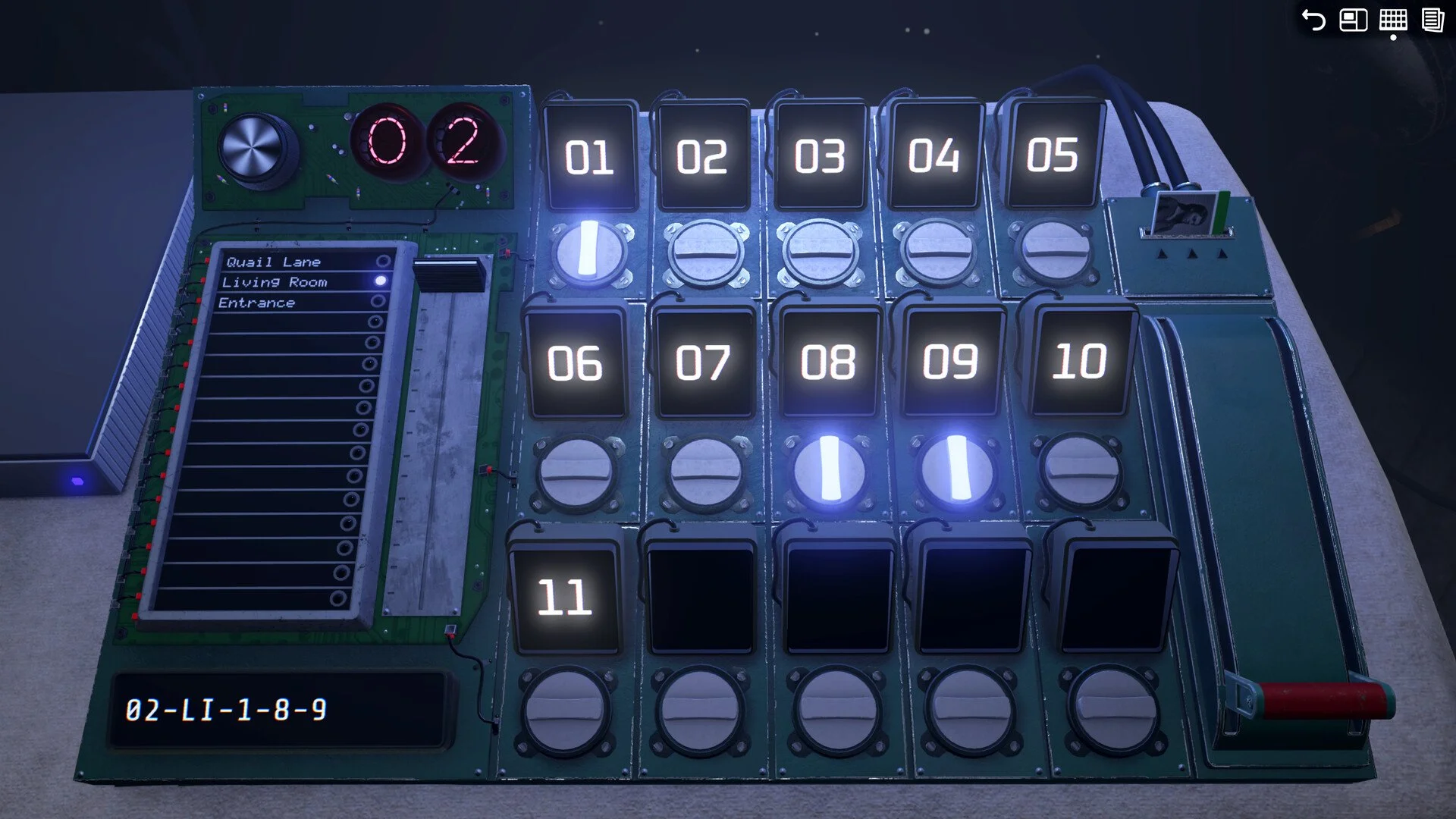
Part of the world-interface of the remake.
It also presents an interesting experiment for interface games in that it'll likely be faithful to the original game in all respects apart from the actual interface.
I'm eagerly waiting to see how it feels to play as what can be inferred from screenshots so far seem like it'll introduce an extra level of representation between you and the original interface. That is, rather than a black screen and a command line on your screen, you basically see the fictional computer that runs the database (or the machines you access it through). There's even a fictional room where the game-you assumedly operates the computer. The fiction, in this way, has gained a new layer in its diegesis.
It'll likely make the game a lot more accessible and it looks super cool! But it's also an entirely different paradigm: the one-to-one equivalence of your screen and the agent's screen feels central to the allure of Type Help. This is like having a good crossword turned into a quiz. I enjoy both but the experience of playing them is very different!
Nevertheless, I'm sure the remake is going to be excellent, and wish it'll bring Type Help to audiences that wouldn't have found it otherwise!
Even if you don't have a soft spot for games that sneakily mesh the extradiegetic with the diegetic, Type Help remains a genuinely cool mystery game with a great story and clever mechanics. I honestly don't know whether to recommend you go play it right now because it's just so good or wait for the remake and play it then.
I guess that depends on how much the notion of interface games resonates with you, and to what degree you wish the interface to encompass your play experience.